Blockchain+ Executive™

  • Leadership Certification: Master blockchain strategies for executive leadership roles
  • Emerging Technologies: Understand trends, synergies, and innovations in blockchain
  • Strategic Training: Learn how to lead digital evolution using blockchain insights
Enroll Now
Blockchain+ Executive™
Self-Paced: $195
Instructor-Led: $295

At a Glance: Course + Exam Overview

Category All Courses, Available Now, Blockchain & Bitcoin, Blockchain Professional, Cryptocurrency Analyst, English, Language
Program Name Blockchain+ Executive™
Duration Instructor-Led:1 Day (live or virtual) | Self-Paced:8 hours (1 Day)
Prerequisites Functional understanding of computing processes and open networks like internet.  Basic knowledge to follow pseudocode to understand a concept.  Ability to understand how various verticals work like finance, supply chains, asset trading etc.  Fundamental understanding of how business utilizes information technology for process efficiencies and optimizations. 
Exam Format 50 questions, 70% passing, 90 minutes, online proctored exam

What You'll Learn

Blockchain Fundamentals Proficiency

Students will learn about blockchain technology's concepts, architecture, and major features. This involves learning about blockchain fundamentals like decentralized consensus, cryptographic hashing, and distributed ledger technology.

Problem-Solving with Blockchain

Learners will gain the ability to analyze and recognize the practical applications of blockchain technology across various sectors. This includes exploring real-world use cases in finance, supply chain management, healthcare, and government services to understand how blockchain can address problems and add value.

Regulations and Compliance

Learners are taught about blockchain law and regulation, including the rules and compliance requirements for blockchain implementation, transactions, and tokenization. This also includes data protection, the legality of smart contracts, and regulations around digital assets.

Risk Management

Students will understand and address blockchain privacy and security issues. Blockchains' economic effects, including tokenomics, decentralized finance (DeFi), and economic model disruption, will also be discussed. Understanding these characteristics will help learners estimate blockchain adoption risks and potential.
Certification Modules

Certification Overview

  • Course Introduction Preview

Module 1: Introduction to Blockchain Technology

  • 1.1 History of Blockchain
  • 1.2 Types of Blockchains: Public, Private, Consortium
  • 1.3 Components of a Blockchain: Blocks, Transactions, Hashing
  • 1.4 Distributed Ledger Technology (DLT)
  • 1.5 Consensus Mechanisms: Proof of Work, Proof of Stake, Practical Byzantine Fault Tolerance (PBFT)
  • 1.6 Cryptographic Techniques: Hash Functions, Digital Signatures, Merkle Trees

Module 2: Blockchain Ecosystem Features

  • 2.1 Immutability and Tamper Resistance
  • 2.2 Transparency and Auditability
  • 2.3 Decentralization and Peer-to-Peer Networking
  • 2.4 Tokenization and Digital Assets
  • 2.5 Interoperability and Cross-Chain Communication
  • 2.6 Scalability and Performance Challenges

Module 3: Real-World Use Cases and Projects

  • 3.1 Finance: Cryptocurrency, Payment Solutions, Stablecoins
  • 3.2 Supply Chain Management: Track and Trace, Counterfeit Prevention
  • 3.3 Healthcare: Electronic Health Records (EHRs), Medical Supply Chain
  • 3.4 Identity Management: Self-Sovereign Identity, KYC Solutions
  • 3.5 Gaming and Entertainment: Non-Fungible Tokens (NFTs), Decentralized Applications (DApps)

Module 4: Blockchain in Finance

  • 4.1 Decentralized Finance (DeFi) Platforms
  • 4.2 Automated Market Makers (AMMs) and Decentralized Exchanges (DEXs)
  • 4.3 Lending Protocols and Yield Farming
  • 4.4 Asset Tokenization: Real Estate, Stocks, and Commodities
  • 4.5 Central Bank Digital Currencies (CBDCs)
  • 4.6 Regulatory Challenges and Compliance Considerations

Module 5: Blockchain in Supply Chain Management

  • 5.1 Transparency and Traceability
  • 5.2 Reduced Counterfeiting and Fraud
  • 5.3 Efficient Inventory Management
  • 5.4 Streamlined Documentation and Compliance
  • 5.5 Improved Supply Chain Financing
  • 5.6 Enhanced Supplier Relationships
  • 5.7 Sustainability and Ethical Sourcing
  • 5.8 Supply Chain Resilience and Risk Management
  • 5.9 Collaborative Supply Chain Networks
  • 5.10 Cost Reduction and Efficiency Gains

Module 6: Blockchain in Healthcare

  • 6.1 Data Security and Integrity
  • 6.2 Interoperability and Data Sharing
  • 6.3 Patient Empowerment and Control
  • 6.4 Streamlined Administrative Processes
  • 6.5 Clinical Trials and Research
  • 6.6 Fraud Detection and Prevention
  • 6.7 Regulatory Compliance
  • 6.8 Telemedicine and Remote Patient Monitoring
  • 6.9 Enhanced Patient Outcomes

Module 7: Blockchain in Government and Public Services

  • 7.1 Transparent and Trustworthy Governance
  • 7.2 Secure and Efficient Identity Management
  • 7.3 Improved Regulatory Compliance
  • 7.4 Enhanced Voting Systems
  • 7.5 Efficient Tax and Revenue Management
  • 7.6 Digital Identity and Credentialing
  • 7.7 Enhanced Supply Chain Management
  • 7.8 Citizen Engagement and Participation

Module 8: Legal And Regulatory Considerations

  • 8.1 Regulatory Compliance
  • 8.2 Smart Contracts and Legal Validity
  • 8.3 Intellectual Property Rights
  • 8.4 Data Privacy and Security
  • 8.5 Cross-Border Transactions
  • 8.6 Tokenization and Securities Regulations
  • 8.7 Liability and Accountability
  • 8.8 Regulatory Sandboxes and Innovation Hubs
  • 8.9 Compliance Technology Solutions
  • 8.10 Evolving Regulatory Landscape

Module 9: Privacy and Security in Blockchains

  • 9.1 Confidentiality Mechanisms
  • 9.2 Permissioned vs. Permissionless Blockchains
  • 9.3 Smart Contract Security
  • 9.4 Immutable Nature of Data
  • 9.5 Network Security

Module 10: Economic Impacts of Blockchains

  • 10.1 Cost Reduction and Efficiency Gains
  • 10.2 Revenue Generation Opportunities
  • 10.3 Market Disruption and Innovation
  • 10.4 Global Trade and Commerce
  • 10.5 Financial Inclusion
  • 10.6 Capital Formation and Investment
  • 10.7 Job Creation and Economic Growth
  • 10.8 Risk Management and Resilience
  • 10.9 Environmental Sustainability

Module 11: Future Trends in Blockchains

  • 11.1 Scalability Solutions
  • 11.2 Decentralized Finance (DeFi)
  • 11.3 Non-Fungible Tokens (NFTs)
  • 11.4 Blockchain and Internet of Things (IoT)
  • 11.5 Regulatory Developments
  • 11.6 Environmental Sustainability

Module 12: Case Studies and Practical Applications

  • 12.1 Enterprise Use Cases
  • 12.2 Project Use Cases
  • 12.3 Country/Government Use Cases

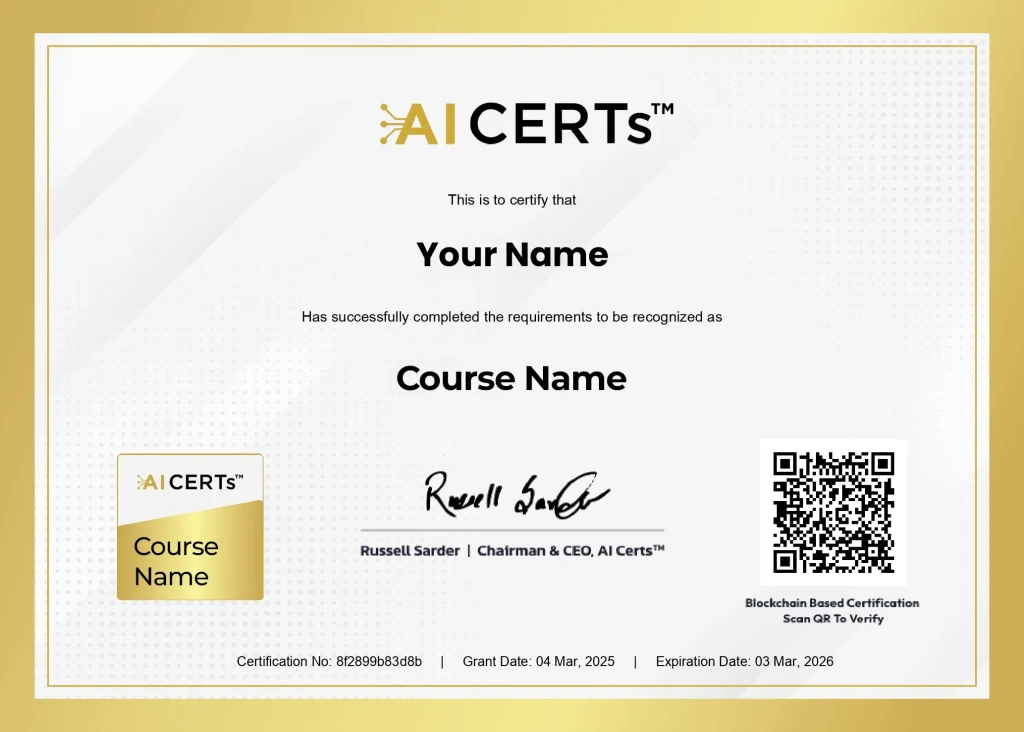
Finish the course and get certified

Course Certificate

Industry Opportunities

Blockchain Business Analysts

Evaluate blockchain opportunities, analyze processes, and create strategies to drive growth through blockchain technology.

Blockchain Consultants

Guide organizations in blockchain adoption, implementation, and optimization to tackle challenges and maximize technology opportunities.

Blockchain Product Managers

Manage blockchain product development, aligning features with market demands and ensuring successful delivery and market fit.

Design Executive

Conceptualize and execute innovative blockchain solutions, architecting infrastructure, and protocols to meet corporate and industry standards.

Frequently Asked Questions

Prerequisites

Exam Details

Passing Score

70%

Format

50 multiple-choice/multiple-response questions

Exam Blueprint

Introduction to Blockchain Technology 6%
Blockchain Ecosystem Features 9%
Real-World Use Cases and Projects 7%
Blockchain in Finance 9%
Blockchain in Supply Chain Management 9%
Blockchain in Healthcare 9%
Blockchain in Government and Public Services 9%
Legal And Regulatory Considerations 9%
Privacy and Security in Blockchains 9%
Economic Impacts of Blockchains 9%
Future Trends in Blockchains 9%
Case Studies and Practical Applications 6%
Self-Paced Online

Self-Paced Online: 8 hours (1 Day)

Price: $195

Instructor-Led Online

Instructor-Led Online: 1 Day (live or virtual)

Price: $295

Core AI Tools Covered