AI+ Security Strategist™

This certification validates advanced-level expertise in AI-driven cybersecurity strategy, governance, and risk management. The exam assesses deep knowledge of advanced security architectures, AI-enabled threat intelligence, and strategic security decision-making within complex enterprise environments.

Enroll Now
AI+ Security Strategist™
Self-Paced: $495

At a Glance: Course + Exam Overview

Category AI Security, AI Technical, All Courses, Available Now
Program Name AI+ Security Strategist™
Duration Instructor-Led:5 days (live or virtual) | Self-Paced:40 hours of content
Prerequisites Foundation in AI+ Security: Completion of AI+ Security Compliance Practitioner and AI+ Security Practitioner.   Intermediate / Advanced Python Programming: Proficiency in Python, including  experience with deep learning tools like TensorFlow and PyTorch.   Advanced Cybersecurity Knowledge: Strong skills in threat detection, incident  response, and securing networks and devices.   Cloud and Blockchain Basics: Understanding of cloud security, container systems,  and blockchain technology.   Linux/CLI Mastery: Advanced command-line skills and experience with security tools in Linux environments.  AI in Security Engineering: Knowledge of AI’s role in identity and access  management (IAM), IoT security, and physical security.  
Exam Format 50 questions, 70% passing, 90 minutes, online proctored exam

Certification Modules

Module 1: Foundations of AI and ML for Security Engineering

  • This module equips you to implement cutting-edge AI-driven security solutions. You’ll explore core algorithms like neural networks, advanced NLP techniques, and deep learning models to analyze security logs. The module also guides you on designing AI pipelines, managing imbalanced datasets, and mitigating adversarial threats, ensuring that your security systems remain adaptive and robust against evolving cyber risks. 

Module 2: ML for Threat Detection and Response

  • This module provides practical expertise in applying supervised and unsupervised learning methods for tasks such as malware classification, anomaly detection, and real-time threat response. You’ll also learn to build advanced pipelines, optimize AI models, and use tools like Apache Kafka and Spark for scalable real-time solutions. 

Module 3: Deep Learning for Security Applications

  • In this module, you’ll gain proficiency in implementing CNNs, RNNs, and hybrid models for network traffic classification, phishing detection, and intrusion analysis. Additionally, you’ll explore autoencoders for anomaly detection and adversarial training methods to strengthen defenses against manipulated inputs. 

Module 4: Adversarial AI in Security

  • This module explores the strategies for crafting secure AI systems, including adversarial training, ensemble methods, and red teaming. You’ll also explore tools for simulating attacks and designing architectures that resist adversarial inputs while maintaining transparency and trust. 

Module 5: AI in Network Security

  • This module teaches you to implement AI-powered IDS, anomaly detection models, and zero-trust architectures. With case studies and hands-on projects, you’ll develop skills in integrating AI into next-generation firewalls and optimizing network security for high-throughput environments. 

Module 6: AI in Endpoint Security

  • In this module, you’ll learn to build AI-based malware detection systems, optimize models for polymorphic threats, and leverage ML for anomaly detection on endpoints. The content also covers securing IoT devices and implementing lightweight AI solutions for resource-constrained environments. 

Module 7: Secure AI System Engineering

  • This module provides expertise in designing robust AI pipelines, incorporating cryptographic techniques, and optimizing models for real-time security. You’ll also explore frameworks for ensuring explainability, scalability, and compliance with data protection regulations. 

Module 8: AI for Cloud and Container Security

  • This module equips you to build AI systems for cloud security, integrate tools into container orchestration platforms like Kubernetes, and deploy AI-driven solutions for serverless architectures. You’ll also explore DevSecOps practices and advanced security testing methods. 

Module 9: AI and Blockchain for Security

  • This module offers insights into integrating AI with blockchain for transaction security, optimizing consensus mechanisms, and safeguarding smart contracts. Practical case studies showcase applications in cryptocurrency exchanges and supply chain management. 

Module 10: AI in Identity and Access Management (IAM)

  • This module focuses on automating role-based access controls, detecting unauthorized access, and implementing AI-driven MFA systems. You’ll also explore real-world applications of reinforcement learning and AI-based fraud detection in IAM scenarios. 

Module 11: AI for Physical and IoT Security

  • This module covers AI solutions for securing smart cities, industrial IoT, and autonomous vehicles. You’ll also learn about federated learning for decentralized security and techniques for safeguarding smart home devices against unauthorized access. 

Module 12: Capstone Project – Engineering AI Security Systems

  • This module guides you through every step, from defining project goals and selecting datasets to integrating AI models into existing infrastructures. You’ll gain hands-on expertise in creating scalable, adaptive, and effective security solutions. 

Finish the course and get certified

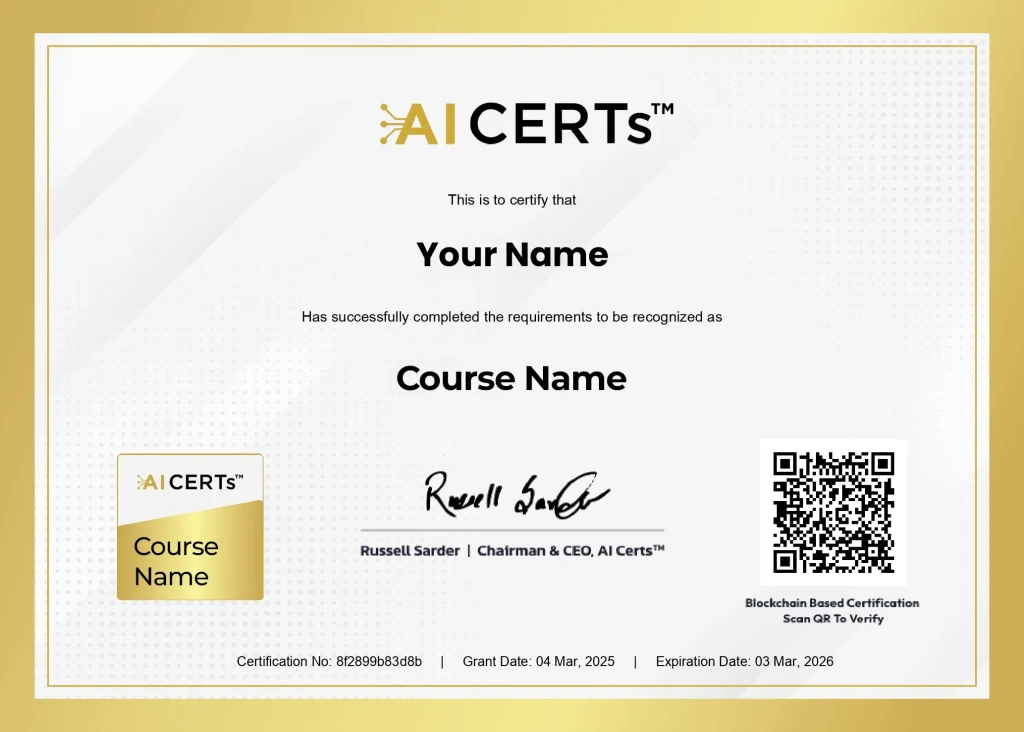
Course Certificate

Industry Opportunities

AI Security Analyst

Uses AI techniques for threat detection, security analysis, and risk identification.

Cybersecurity Engineer

Implements AI-powered security solutions and defense strategies.

SOC Analyst

Uses AI tools for security monitoring, investigation, and incident response.

AI Threat Intelligence Analyst

Identifies emerging threats using AI-driven analysis.

Cloud Security Engineer

Applies AI solutions to protect cloud environments.

Penetration Tester

Uses AI-based techniques to identify vulnerabilities.

Security Consultant

Advises organizations on AI-driven cybersecurity strategies.

Frequently Asked Questions

Prerequisites

Exam Details

Passing Score

70%

Format

50 multiple-choice/multiple-response questions

Exam Blueprint

Foundations of AI and Machine Learning for Security Engineering 5%
Machine Learning for Threat Detection and Response 5%
Deep Learning for Security Applications 5%
Adversarial AI in Security 6%
AI in Network Security 6%
AI in Endpoint Security 8%
Secure AI System Engineering 8%
AI for Cloud and Container Security 11%
AI and Blockchain for Security 11%
AI in Identity and Access Management (IAM) 12%
AI for Physical and IoT Security 12%
Capstone Project - Engineering AI Security Systems 11%
Self-Paced Online

Self-Paced Online: 40 hours of content

Price: $495

Instructor-Led Online

Instructor-Led Online: 5 days (live or virtual)

Core AI Tools Covered