AI+ Doctor™

  • Clinical Intelligence Focus: Designed for medical professionals to integrate AI into patient care and diagnostics
  • Data-Driven Decisions: Equips doctors with tools to interpret AI-generated insights for precise treatment planning
  • Comprehensive Medical AI Knowledge: Covers AI applications from predictive analytics to medical imaging and virtual health
  • Future-Ready Expertise: Empowers healthcare practitioners to lead AI-driven innovations in clinical practice
Enroll Now
AI+ Doctor™
Self-Paced: $195
Instructor-Led: $295

At a Glance: Course + Exam Overview

Category AI Healthcare, AI Professional, All Courses, Available Now, Doctor / Physician, English, Language
Program Name AI+ Doctor™
Duration Instructor-Led:1 day (live or virtual) | Self-Paced:8 hours (1 Day)
Prerequisites Basic Medical Knowledge: Participants should have foundational knowledge of clinical practices, medical terminology and patient care processes. Familiarity with Healthcare Systems: A basic understanding of healthcare systems, including electronic health records (EHRs) and patient workflows will be beneficial. Interest in Technology Integration: A keen interest in exploring the intersection of AI and healthcare, along with a willingness to learn about AI applications in medical settings. Data Literacy: A basic understanding of data concepts, including data collection, analysis, and interpretation, is recommended for understanding AI models and metrics. Problem-Solving Mindset: Ability to approach challenges with a solutions-oriented mindset, especially when evaluating AI systems and adapting them to clinical settings.
Exam Format 50 questions, 70% passing, 90 minutes, online proctored exam

What You'll Learn

AI in Clinical Settings

Gain a comprehensive understanding of AI's role in diagnostics, patient care, and workflow optimization in clinical settings.

AI Integration in Patient Care

Learn how to identify department-specific AI use cases and integrate AI across different stages of patient care.

Evaluating AI Performance

Understand how to evaluate AI performance, ensuring its effectiveness and regulatory compliance in healthcare environments.

Ethical AI Implementation

Explore ethical considerations, algorithmic bias, and transparency to ensure responsible and effective AI implementation in healthcare.
Certification Modules

Module 1: What is AI for Doctors?

  • 1.1 From Decision Support to Diagnostic Intelligence
  • 1.2 What Makes AI in Medicine Unique?
  • 1.3 Types of Machine Learning in Medicine
  • 1.4 Common Algorithms and What They Do in Healthcare
  • 1.5 Real-World Use Cases Across Medical Specialties
  • 1.6 Debunking Myths About AI in Healthcare
  • 1.7 Real Tools in Use by Clinicians Today
  • 1.8 Hands-on: Medical Imaging Analysis using MediScan AI

Module 2: AI in Diagnostics & Imaging

  • 2.1 Introduction to Neural Networks: Unlocking the Power of AI
  • 2.2 Convolutional Neural Networks (CNNs) for Visual Data: Seeing with AI’s Eyes
  • 2.3 Image Modalities in Medical AI: AI’s Multi-Modal Vision
  • 2.4 Model Training Workflow: From Data Labeling to Deployment – The AI Lifecycle in Medicine
  • 2.5 Human-AI Collaboration in Diagnosis: The Power of Augmented Intelligence
  • 2.6 FDA-Approved AI Tools in Diagnostic Imaging: Trust and Validation
  • 2.7 Hands-on Activity: Exploring AI-Powered Differential Diagnosis with Symptoma

Module 3: Introduction to Fundamental Data Analysis

  • 3.1 Understanding Clinical Data Types – EHRs, Vitals, Lab Results
  • 3.2 Structured vs. Unstructured Data in Medicine
  • 3.3 Role of Dashboards and Visualization in Clinical Decisions
  • 3.4 Pattern Recognition and Signal Detection in Patient Data
  • 3.5 Identifying At-Risk Patients via Trends and AI Scores
  • 3.6 Interactive Activity: AI Assistant for Clinical Note Insights

Module 4: Predictive Analytics & Clinical Decision Support – Empowering Proactive Patient Care

  • 4.1 Predictive Models for Risk Stratification – Sepsis and Hospital Readmissions
  • 4.2 Logistic Regression, Decision Trees, Ensemble Models
  • 4.3 Real-Time Alerts – Early Warning Systems (MEWS, NEWS)
  • 4.4 Sensitivity vs. Specificity – Metric Choice by Clinical Need
  • 4.5 ICU and ER Use Cases for AI-Triggered Interventions

Module 5: NLP and Generative AI in Clinical Use

  • 5.1 Foundations of NLP in Healthcare
  • 5.2 Large Language Models (LLMs) in Medicine
  • 5.3 Prompt Engineering in Clinical Contexts
  • 5.4 Generative AI Use Cases – Summarization, Counselling Scripts, Translation
  • 5.5 Ambient Intelligence: Next-Gen Clinical Documentation
  • 5.6 Limitations & Risks of NLP and Generative AI in Medicine
  • 5.7 Case Study: Transforming Clinical Documentation and Enhancing Patient Care with Nabla Copilot

Module 6: Ethical and Equitable AI Use

  • 6.1 Algorithmic Bias – Race, Gender, Socioeconomic Impact
  • 6.2 Explainability and Transparency (SHAP and LIME)
  • 6.3 Validating AI Across Populations
  • 6.4 Regulatory Standards – HIPAA, GDPR, FDA/EMA Compliance
  • 6.5 Drafting Ethical AI Use Policies
  • 6.6 Case Study – Biased Pulse Oximetry Detection

Module 7: Evaluating AI Tools in Practice

  • 7.1 Core Metrics: Understanding the Basics
  • 7.2 Confusion Matrix & ROC Curve Interpretation
  • 7.3 Metric Matching by Clinical Context
  • 7.4 Interpreting AI Outputs: Enhancing Clinical Decision-Making
  • 7.5 Critical Evaluation of Vendor Claims: Ensuring Reliability and Effectiveness
  • 7.6 Red Flags in Commercial AI Tools: Recognizing and Mitigating Risks
  • 7.7 Checklist: “10 Questions to Ask Before Buying AI Tools”
  • 7.8 Hands-on

Module 8: Implementing AI in Clinical Settings

  • 8.1 Identifying Department-Specific AI Use Cases
  • 8.2 Mapping AI to Workflows (Pre-diagnosis, Treatment, Follow-up)
  • 8.3 Pilot Planning: Timeline, Data, Feedback Cycles
  • 8.4 Team Roles – Clinical Champion, AI Specialist, IT Admin
  • 8.5 Monitoring AI Errors – Root Cause Analysis
  • 8.6 Change Management in Clinical Teams
  • 8.7 Example: ER Workflow with Triage AI Integration
  • 8.8 Scaling AI Solutions Across the Healthcare System
  • 8.9 Evaluating AI Impact and Performance Post-Deployment

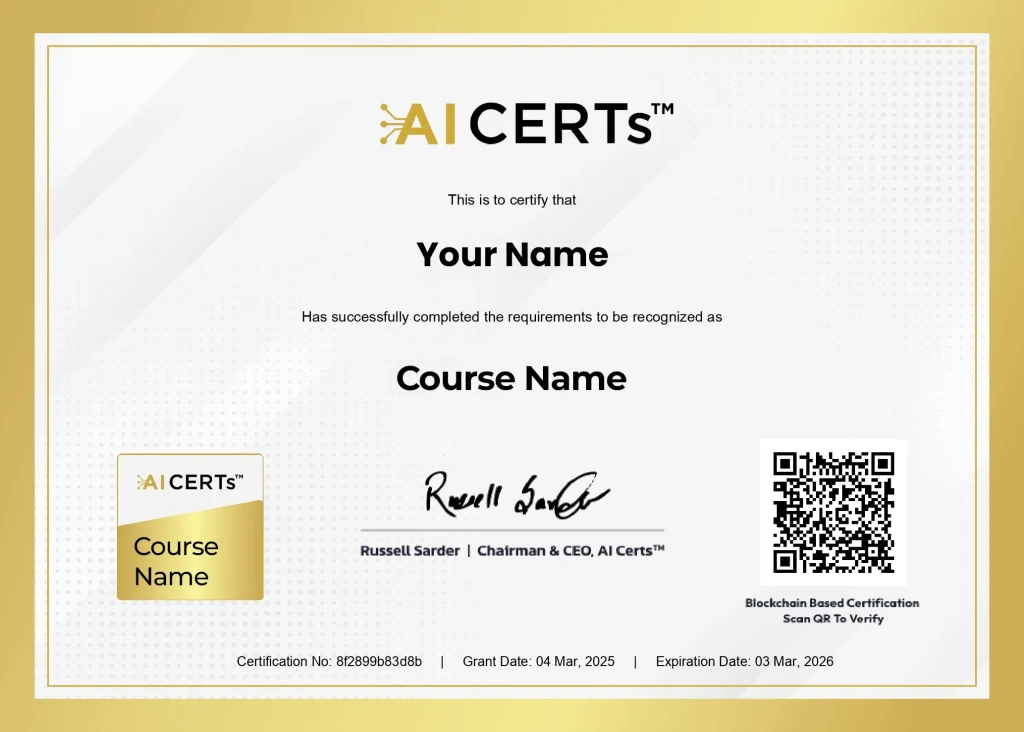
Finish the course and get certified

Course Certificate

Industry Opportunities

AI Healthcare Consultant

Advise hospitals and clinics on adopting AI solutions to improve diagnostics, patient care, and operational efficiency.

Clinical AI Implementation Lead

Oversee the deployment of AI-powered systems in clinical settings to streamline workflows, reduce errors, and enhance care delivery.

AI Medical Data Analyst

Develop and apply AI models to analyze patient data, predict health trends, and support evidence-based treatment decisions.

Healthcare Innovation Manager

Drive AI integration in medical practice to enhance patient outcomes and streamline clinical processes.

Chief Medical AI Officer (CMAIO)

Lead strategic AI adoption in healthcare to drive innovation, digital transformation, and personalized medicine.

Frequently Asked Questions

Prerequisites

Exam Details

Passing Score

70%

Format

50 multiple-choice/multiple-response questions

Exam Blueprint

What is AI for Doctors? 9%
AI in Diagnostics & Imaging 13%
Introduction to Fundamental Data Analysis 13%
Predictive Analytics & Clinical Decision Support - Empowering Proactive Patient Care 13%
NLP and Generative AI in Clinical Use 13%
Ethical and Equitable AI Use 13%
Evaluating AI Tools in Practice 13%
Implementing AI in Clinical Settings 13%
Self-Paced Online

Self-Paced Online: 8 hours (1 Day)

Price: $195

Instructor-Led Online

Instructor-Led Online: 1 day (live or virtual)

Price: $295

Core AI Tools Covered